A Symbol of Trust & Scottish Craftsmanship
At Ramsay Pagett, every piece begins with integrity. Hallmarking is more than a legal requirement — it is a promise of purity, authenticity, and the highest standard of craftsmanship. For centuries, British (and proudly Scottish) hallmarking has safeguarded the quality of precious metals, preserving a tradition built on trust.
A Legacy Forged in History
Hallmarking traces its origins to the 13th century, when King Edward I introduced legislation requiring all gold and silver to be assayed and marked for quality. This early system protected buyers from fraud and upheld the reputation of skilled artisans throughout the British Isles.
Today, this tradition continues through the UK’s four historic assay offices. As a Scottish silversmith, our work is proudly tested and hallmarked by the Edinburgh Assay Office, the only assay office in Scotland, identified by its iconic Castle mark.
What Is a Hallmark?
A hallmark is a series of small stamped or laser-applied symbols found on jewellery and silverware made from precious metals — Platinum, Gold, Palladium, and Silver.
Placed discreetly (for example, inside a ring shank or on a clasp), each hallmark provides independent verification of:
Who made the piece
What precious metal it is
Its level of purity
Which assay office tested it
Possibly when it was made
These marks give complete transparency and offer reassurance that your piece is genuine, responsibly made, and crafted to the highest standard.
The Minimum Compulsory UK Hallmark
Every item sold as precious metal in the UK must carry three compulsory marks:
Sponsor’s Mark — identifying the maker or brand
Millesimal Fineness Mark — confirming metal purity
Assay Office Mark — showing where it was tested (for us: Edinburgh’s Castle)
Additional marks can also be included:
Traditional Fineness Mark
Date Letter Mark
Commemorative Mark
Convention Mark
A Full UK Traditional Hallmark contains five symbols: Sponsor’s Mark, Traditional Fineness Mark, Millesimal Fineness Mark, Assay Office Mark, and Date Letter.
Understanding Each Mark
Sponsor’s Mark
Compulsory
This is the registered mark of the maker or brand that submitted the item for testing.
Every sponsor’s mark is unique and traceable, ensuring accountability and authenticity.
Ramsay Pagett’s Sponsor’s Mark is
Millesimal Fineness Mark
Compulsory
This symbol confirms the precious metal purity, expressed in parts per thousand (e.g., 925 for Sterling Silver).
Each metal type has a different Shaped shield, allowing instant identification.
The Assay Office always marks to the lowest purity present, ensuring the metal is never overstated.
Assay Office Mark — Edinburgh
Compulsory
This symbol tells you where the item was tested and hallmarked.
We work exclusively with the Edinburgh Assay Office, represented by:
The Castle mark
A symbol of Scotland’s heritage, strength, and proud tradition of exceptional craftsmanship.
Traditional Fineness Mark
Optional
These long-established symbols further clarify the metal type.
They are not compulsory, but may appear alongside the compulsory fineness mark.
Date Letter Mark
Optional since 1999
Each year is assigned a unique letter, helping identify when the piece was hallmarked.
This is especially useful for collectors or those valuing the historical significance of their jewellery or silverware.
Commemorative Marks
Optional
Applied to celebrate national events, these marks offer additional insight into the moment an item was created.
Convention Mark
Recognised internationally, the Convention Mark is used by countries participating in the International Convention on Hallmarking, enabling easier cross-border trade.
How Hallmarks Are Applied
Hallmarks are traditionally stamped, though modern techniques often use laser marking — ideal for delicate, intricate, or stone-set designs.
Laser marking preserves the integrity of the piece, avoiding distortion.
If an item with a laser hallmark requires resizing, it may need to be re-hallmarked to ensure legibility and compliance.
Where Hallmarks Are Placed
Hallmarks are positioned discreetly to respect the design:
Inside ring shanks
On necklace clasps
On earring posts
On the underside of silver objects
This ensures the hallmark is present but never intrusive.
Craftsmanship You Can Trust
For us, hallmarking is not just a technical detail — it is a celebration of Scotland’s silversmithing heritage. The hallmark guarantees that every Ramsay Pagett piece is genuine, responsibly crafted, and made to last for generations.
If you have any questions about hallmarking or wish to learn more about our process, please feel free to get in touch. We’re always happy to help.

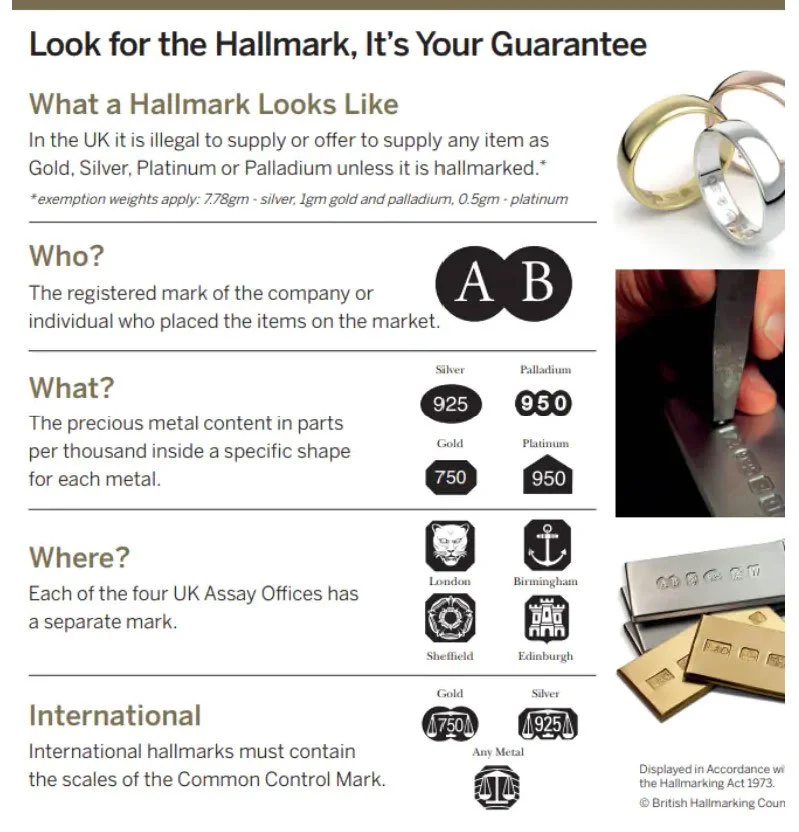
Displayed in accordance with the Hallmarking Act 1973
©British Halmarking Council